

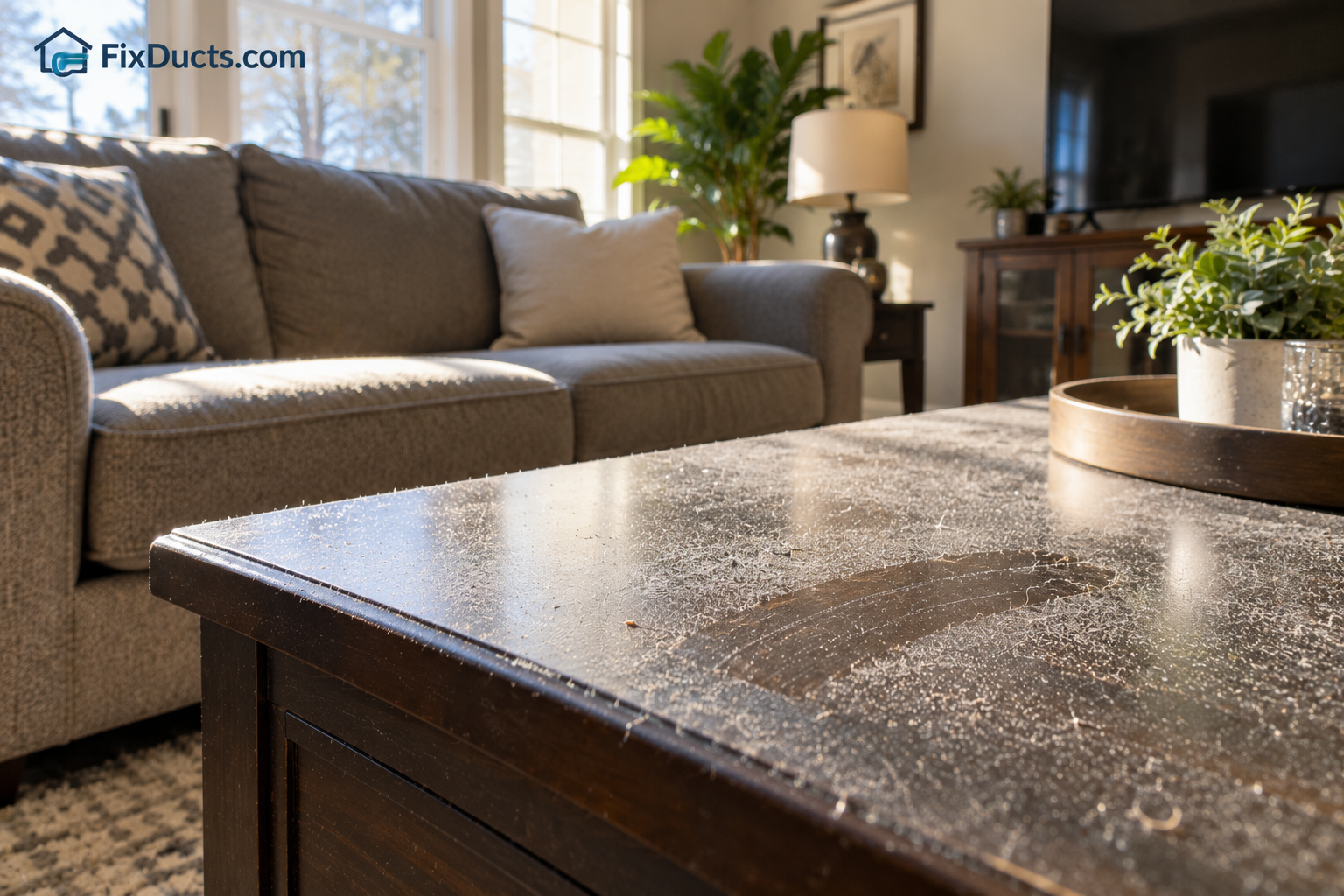
Does your house seem to get dusty again just a day or two after cleaning? You wipe the furniture, vacuum the floors, and clean the shelves, only to notice another layer of dust shortly afterward. This is a common problem in many homes, and it can have several causes.
Household dust is a mixture of tiny particles that may come from outdoor soil, fabric fibers, skin flakes, cooking activities, pet dander, and other indoor sources. Dust can enter through doors and windows, settle from the air, or accumulate in areas that are difficult to clean.
Your heating, ventilation, and air conditioning (HVAC) system may also affect how dust moves around your home. However, a dusty house does not automatically mean that your air ducts need professional cleaning.
In this guide, you will learn why your house gets dusty so quickly, how your HVAC system may contribute, and what practical steps can help reduce dust buildup.
What Causes a House to Get Dusty So Quickly?
Several factors can contribute to excessive dust accumulation. Identifying the main sources in your home can help you choose the right solution instead of repeatedly cleaning the same surfaces.
1. Dust Enters Through Doors and Windows
Outdoor particles are a common source of indoor dust. Soil, pollen, road dust, and other airborne particles can enter when you open windows and doors.
Homes near busy roads, construction sites, dry soil, or unpaved areas may experience more outdoor dust than homes in less exposed locations.
Dust can also enter on shoes, clothing, bags, and pets. Once inside, these particles settle on floors, furniture, window sills, and other surfaces.
How to reduce it:
- Keep windows closed when outdoor dust levels are high.
- Use well-fitted door sweeps and weatherstripping where appropriate.
- Place doormats at exterior entrances.
- Remove shoes before walking through the house.
- Clean entryways regularly to prevent tracked-in dirt from spreading.
You do not need to keep your home sealed at all times. Ventilation is important, so choose appropriate times and methods to bring in outdoor air while limiting the entry of unwanted particles.
2. Your HVAC Air Filter Is Dirty or Incorrectly Installed
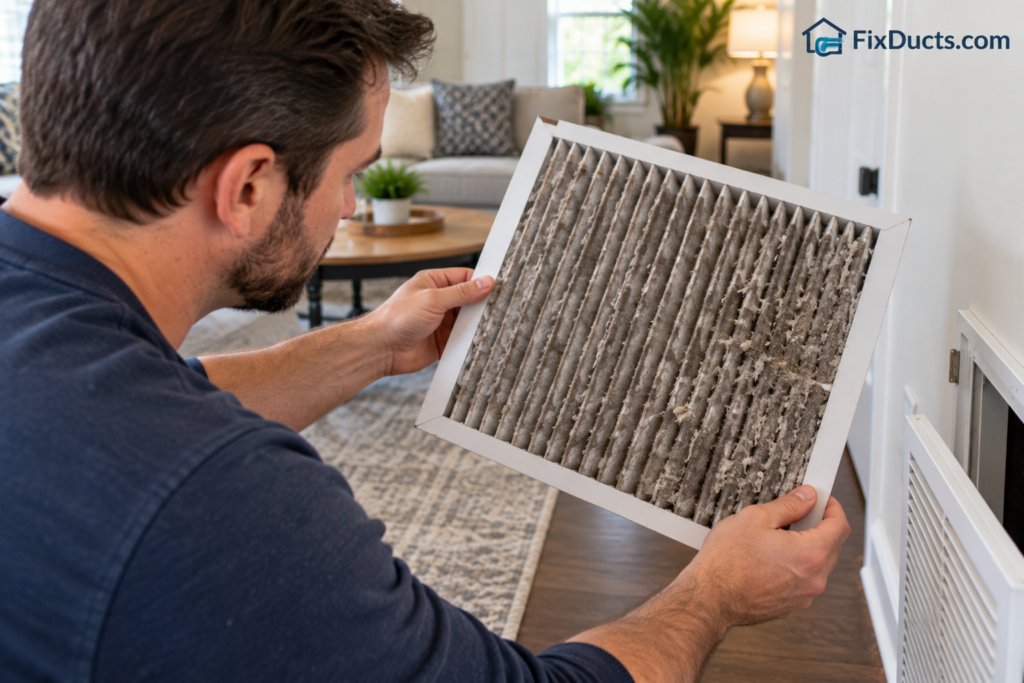
Your HVAC system circulates air through your home, and its filter captures some airborne particles before they reach the equipment.
When a filter becomes loaded with dust, airflow may be restricted, depending on the filter and system. A poorly fitted filter can also allow air to bypass the filter rather than pass through it.
A filter that is installed backward, damaged, or the wrong size may not work as intended.
However, replacing a filter does not remove all dust from a home. Some particles settle on surfaces before reaching a return vent, while others enter from outside or are generated by everyday activities.
How to reduce it:
- Check your HVAC filter according to the manufacturer’s recommendations.
- Replace disposable filters when needed.
- Clean reusable filters only as instructed by the manufacturer.
- Confirm that the filter fits securely in its slot.
- Use the filter type and efficiency rating appropriate for your HVAC equipment.
Avoid assuming that the highest-rated filter is always the best option. A filter with excessive resistance can interfere with airflow in a system that is not designed to accommodate it.
For more information, see our guide: How Often Should You Change Your HVAC Air Filter?
3. Your Home Has Air Leaks
Small gaps around exterior doors, windows, utility penetrations, and other openings can allow outdoor particles to enter your home.
In some houses, poorly sealed connections around ductwork may also allow dust from attics, crawl spaces, or other unconditioned areas to enter the air distribution system. This depends on the location and condition of the ducts.
Air leaks do not all have the same effect. A gap in an exterior wall may allow outdoor air inside, while a leaking return duct in a dusty area can draw unwanted particles into the HVAC system.
How to reduce it:
- Inspect visible gaps around windows and exterior doors.
- Replace worn weatherstripping where necessary.
- Seal appropriate small gaps with compatible materials.
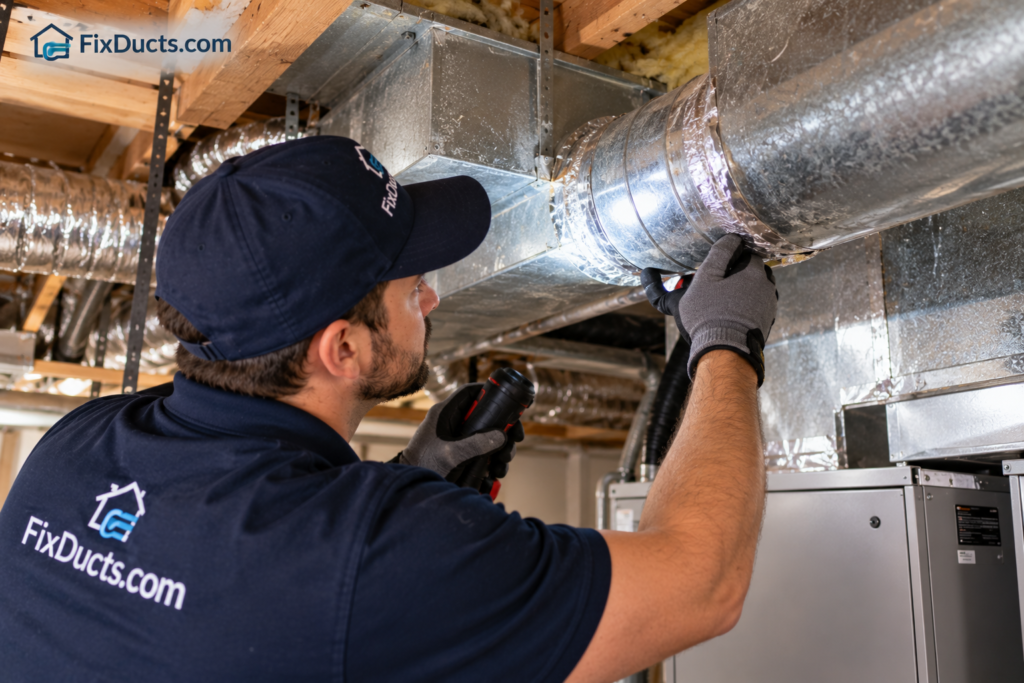
- Have accessible duct connections inspected if you suspect leakage.
- Consult a qualified professional for duct leaks in difficult-to-access areas.
Do not seal intentional ventilation openings or combustion-air openings. If you are unsure whether an opening should remain clear, ask a qualified professional.
4. Carpets, Rugs, and Upholstered Furniture Hold Dust
Soft furnishings can collect dust, hair, skin flakes, fabric fibers, and other particles. Walking, sitting, or moving cushions may release some of these particles back into the air.
Carpets and thick rugs can hold more debris than smooth floors, particularly in busy areas. Upholstered sofas, curtains, mattresses, and decorative pillows can also collect dust over time.
This does not mean you must remove every carpet or fabric item. Regular cleaning can help prevent accumulated particles from spreading throughout the home.
How to reduce it:
- Vacuum carpets and rugs regularly.
- Use a vacuum cleaner with effective filtration and a well-sealed design.
- Vacuum upholstered furniture according to its care instructions.
- Wash suitable curtains, pillow covers, and bedding regularly.
- Clean underneath furniture instead of focusing only on visible surfaces.
If you have pets or a busy household, you may need to clean soft furnishings more frequently.
5. Pets Contribute Hair and Dander
Pets can contribute to household dust through shed hair, skin flakes, and particles carried in on their paws and coats. Their bedding and favorite resting places can also accumulate debris.
Pet hair is visible, but dander and other fine particles may be much less noticeable.
How to reduce it:
- Brush pets regularly in a suitable area.
- Wash pet bedding according to its care instructions.
- Vacuum areas where pets spend the most time.
- Clean pet hair from upholstery and rugs.
- Keep HVAC filters maintained according to the recommended schedule.
If pet allergies are a concern, remember that reducing visible dust alone may not eliminate the allergens that cause symptoms.
6. Cooking and Everyday Activities Produce Particles
Dust does not only come from outdoors. Normal household activities can generate particles that settle on surfaces or remain suspended in the air.
Cooking can release fine particles, particularly when frying, grilling, or cooking at high temperatures. Candles, fireplaces, and tobacco smoke can also add airborne particles. Craft projects, sanding, and certain cleaning activities may generate additional dust.
How to reduce it:
- Use a range hood that vents outdoors when available and appropriate.
- Run kitchen ventilation during cooking.
- Avoid burning candles or other materials excessively indoors.
- Use appropriate ventilation when carrying out dusty household projects.
- Clean cooking surfaces and nearby areas regularly.
Never use an outdoor barbecue or fuel-burning appliance indoors unless it is specifically designed and approved for that use.
7. Your Cleaning Method Spreads Dust Instead of Removing It
The tools you use can influence how much dust remains after cleaning.
Dry dusting with an unsuitable cloth may push particles onto nearby surfaces or release them into the air. Vacuum cleaners with poor filtration or leaks may also allow some collected particles to escape.
Cleaning surfaces in the wrong order can create extra work. For example, vacuuming first and then dusting high shelves can cause particles to settle onto a floor you have already cleaned.
How to reduce it:
Follow a consistent cleaning routine:
- Dust higher surfaces first.
- Use a slightly damp microfiber cloth on suitable surfaces.
- Work from the top of a room toward the floor.
- Vacuum carpets and upholstered furniture.
- Clean hard floors last.
- Empty or maintain cleaning equipment according to its instructions.
The goal is to capture and remove dust rather than simply move it from one location to another.
8. Clutter Creates More Places for Dust to Collect
Books, decorations, open shelving, unused objects, and piles of clothing provide additional surfaces where dust can settle.
Clutter also makes it harder to reach corners, baseboards, shelves, and the spaces beneath furniture. As a result, dust may accumulate for longer periods.
How to reduce it:
- Store infrequently used items in closed containers.
- Keep frequently used surfaces relatively clear.
- Organize shelves so they are easier to wipe.
- Clean under furniture when practical.
- Wash or clean decorative fabrics periodically.
Reducing clutter does not eliminate the sources of dust, but it can make regular cleaning faster and more effective.
9. Air Ducts May Be Contributing to the Problem
Your HVAC ductwork may contribute to dust problems in certain circumstances, but it should not automatically be considered the cause of a dusty home.
Some dust naturally settles inside ductwork over time. This alone does not prove that the ducts are releasing harmful quantities of particles into your living space.
Duct-related problems are more concerning when there is substantial debris inside the system, evidence of pests, visible contamination, or dust being released from supply registers in unusual amounts.
Leaking or damaged ducts may also allow particles from dusty spaces to enter the system, depending on the duct’s location and whether it is a supply or return duct.
What you can do:
- Inspect accessible supply registers and return grilles.
- Check whether the air filter is installed correctly.
- Look for visible damage around accessible duct connections.
- Pay attention to whether dust appears concentrated near particular vents.
- Ask an HVAC professional to investigate persistent problems that have no obvious explanation.
Professional air duct cleaning may be appropriate when specific conditions justify it. The U.S. Environmental Protection Agency does not recommend routine duct cleaning for every home.
If you suspect a leak, repair or sealing may be more appropriate than cleaning alone. For additional guidance, read our article about signs of leaky air ducts.
10. Indoor Humidity and Ventilation May Affect Dust
Humidity and ventilation influence how particles behave indoors, but neither provides a universal solution to household dust.
Very dry conditions can make some particles easier to disturb, while excessive humidity can encourage moisture problems and mold growth. Ventilation may help remove some indoor pollutants, but outdoor air can also introduce dust and pollen when those particles are present outside.
For many homes, the practical goal is to control moisture, provide suitable ventilation, and use appropriate filtration rather than trying to achieve a particular humidity level solely to eliminate dust.
How to reduce it:
- Monitor indoor humidity with a suitable hygrometer.
- Address leaks and persistent moisture promptly.
- Use kitchen and bathroom exhaust fans where appropriate.
- Ventilate when outdoor conditions are suitable.
- Consider filtration that matches your home’s needs and HVAC system.
Avoid adding unnecessary moisture to your home in an attempt to control dust. Humidity management should also account for the risk of condensation and mold.
How to Tell Where the Dust Is Coming From
Before buying new equipment or paying for a cleaning service, look for patterns in where dust accumulates.
| What you notice | Possible explanation | What to check |
| Dust appears near windows and exterior doors | Outdoor particles entering the home | Window gaps, door seals, and outdoor conditions |
| Dust accumulates around pet resting areas | Hair, dander, and tracked-in particles | Pet bedding, upholstery, and vacuuming routine |
| Dust is concentrated around return grilles | Nearby surface dust or a possible airflow issue | Filter fit, grille cleanliness, and accessible ductwork |
| Dust increases during cooking | Cooking-related airborne particles | Range hood and kitchen ventilation |
| Dust returns quickly after cleaning | Several possible indoor and outdoor sources | Cleaning method, soft furnishings, filter condition, and air leaks |
| Dust appears to blow from a supply vent | Dust near the register or a possible system issue | Register condition, filter installation, and professional inspection if persistent |
These observations are clues, not definitive diagnoses. A dusty vent does not by itself prove that the entire duct system needs cleaning.
Can an Air Purifier Help With a Dusty House?
A properly sized portable air purifier with a high-efficiency particle filter can reduce some airborne particles in the room where it operates. Its effectiveness depends on the device’s clean air delivery rate, room size, placement, and operating speed.
However, air purifiers do not remove dust that has already settled on floors, shelves, or furniture. They also do not correct duct leaks, prevent all outdoor particles from entering, or replace regular cleaning.
If you choose an air purifier:
- Select a model appropriate for the room size.
- Check its clean air delivery rate (CADR) and particle filtration specifications.
- Follow the manufacturer’s filter replacement instructions.
- Avoid devices that intentionally generate ozone.
A portable purifier can be useful as part of a broader dust-reduction plan, especially in rooms where people spend a lot of time.
How Often Should You Clean Your House to Control Dust?
There is no single schedule that works for every household. Cleaning frequency depends on pets, occupancy, outdoor conditions, flooring, cooking habits, and individual sensitivities.
A practical starting routine may look like this:
- Several times per week, as needed: Remove visible dust from frequently used surfaces and clean high-traffic floors.
- Weekly: Vacuum carpets and rugs, clean commonly used furniture, and dust shelves and other surfaces.
- Regularly: Wash bedding and suitable fabric covers, clean under furniture, and remove debris from entryways.
- According to the manufacturer’s schedule: Inspect and replace HVAC filters.
- When necessary: Clean HVAC registers and arrange professional inspection if there is evidence of a system problem.
Adjust the schedule based on how quickly dust accumulates in your home. The objective is consistent removal, not cleaning every surface every day.
When Should You Call an HVAC Professional?
Most ordinary household dust problems can be addressed by improving cleaning habits, maintaining filters, and reducing particle entry. However, professional assessment may be appropriate when you notice persistent problems that suggest an HVAC fault.
Consider an inspection if:
- Dust repeatedly appears to blow from supply vents.
- You discover damaged or disconnected ductwork.
- There is evidence of pests inside the duct system.
- You suspect substantial contamination inside accessible ducts.
- Airflow changes significantly or some rooms receive much less air than expected.
- You notice moisture or visible mold involving HVAC components.
If you suspect mold, moisture, or contaminated materials, the underlying cause should be identified and corrected. Cleaning alone may not resolve a recurring problem.
Choose a qualified professional who explains the findings, identifies the proposed work, and distinguishes necessary repairs from optional services.
Frequently Asked Questions
Why does my house get dusty one day after cleaning?
Dust can return quickly because particles continue to enter and form inside the home. Outdoor air, clothing, pets, cooking, fabrics, and normal movement can all contribute. The speed of accumulation depends on your home’s conditions and cleaning routine.
Does a dusty house mean my air ducts need cleaning?
No. Dust can come from many sources unrelated to the ductwork. Check your filter, cleaning methods, entryways, pets, and furnishings first. Consider duct cleaning when there is evidence of a specific contamination problem.
Can a dirty HVAC filter make my house dusty?
A loaded, damaged, incorrectly sized, or poorly fitted filter can affect how the system handles airborne particles. However, a dirty filter is not the only possible cause of dust. Check the filter and installation against the equipment manufacturer’s recommendations.
Will an air purifier stop dust from collecting on furniture?
An air purifier can reduce some airborne particles, which may help reduce the amount that settles later. It cannot prevent all dust buildup or remove particles that have already settled on surfaces.
Are house dust and air duct dust the same thing?
Not necessarily. Household dust can contain outdoor soil, fibers, skin flakes, pet dander, and other materials. Dust inside ductwork may contain some of these particles, but its composition and significance depend on the system and surrounding conditions.
Can sealing air ducts reduce dust?
Properly sealing certain leaking ducts may reduce the entry of particles from dusty attics, crawl spaces, or other areas. The benefit depends on the location and type of leak. Duct sealing does not address every source of household dust.
Should I replace my HVAC filter every month?
Not every filter needs monthly replacement. The appropriate interval depends on the filter type, system, household conditions, and manufacturer’s recommendations. Check the filter regularly and replace it when required.
Final Thoughts
If your house gets dusty quickly, the cause is often a combination of outdoor particles, everyday household activities, soft furnishings, pets, cleaning habits, and ventilation conditions.
Start with the basics: maintain your HVAC filter, clean surfaces with methods that capture dust, vacuum regularly, reduce clutter, and address gaps that allow unwanted particles to enter. If dust appears to come from your HVAC system or you discover damaged ductwork, investigate the underlying issue before paying for additional services.
Air duct cleaning can be useful in specific circumstances, but it is not a universal solution for a dusty home. Identifying the source of the problem is the most practical way to choose an effective response.
References
- U.S. Environmental Protection Agency (EPA): Should You Have the Air Ducts in Your Home Cleaned?
- U.S. Environmental Protection Agency (EPA): A Guide to Air Cleaners in the Home.
- U.S. Environmental Protection Agency (EPA): Care for Your Air — A Guide to Indoor Air Quality.